
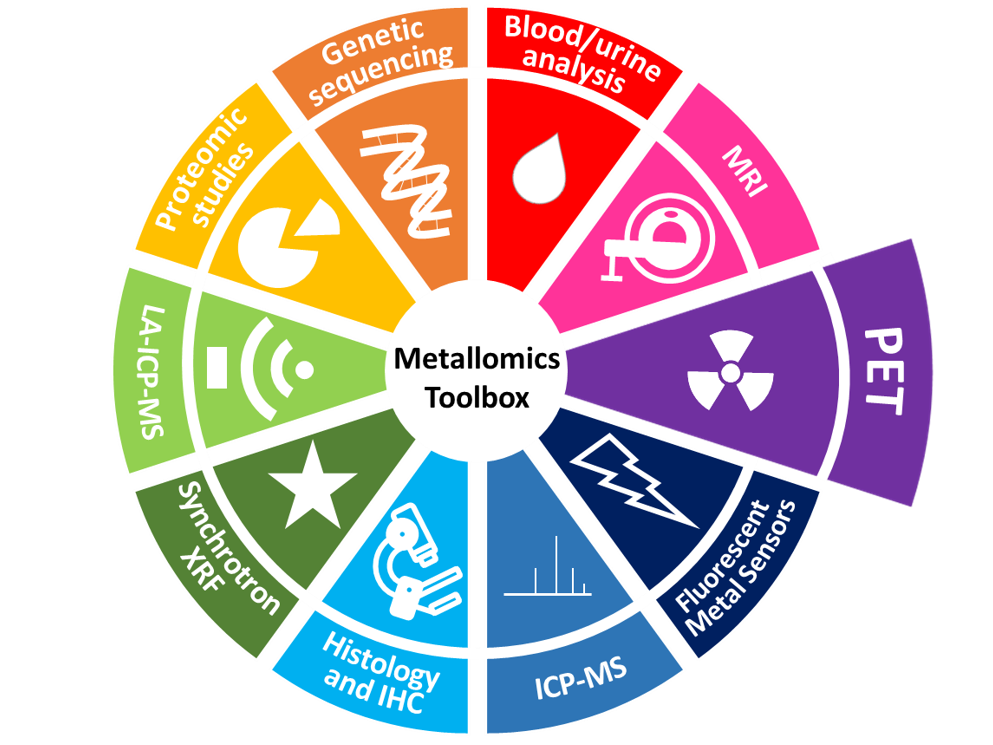
Metallomics toolbox
Metallomics, the study of metals in biological systems, stands at the forefront of completely transforming our understanding of health, disease, and the environment, offering solutions that transcend disciplines and hold the key to new horizons of break-through research. Until recently, Metallomics relied largely on destructive analytical techniques limited to a single spatiotemporal location and microscopic scale without a clear clinically translational path. We have already established a research niche that addresses this critical unmet need in the field; the non-invasive study of the acute dynamics of metal trafficking in vivo across the whole-body in health and disease. I have identified the potential of this approach, termed PET Metallomics, and have led international collaborations to study metal trafficking using in vivo murine models of breast cancer, prostate cancer, diabetes, and manganism.
Nuclear medicine techniques like Positron Emission Tomography (PET) uses picomolar quantities of radioactive substances to study biological processes by three-dimensional, non-invasive dynamic imaging of their distribution in the whole body, exploiting the tissue-penetrating power of gamma radiation. In the clinic, the PET radiotracer fluorodeoxyglucose ([18F]FDG) containing the positron-emitting radionuclide 18F accounts for over 90% of all scans and remains the standard for the diagnosis of cancer by providing information on glucose metabolism. The use of radiometals to study metal trafficking by PET is less well-established because the radiometals most convenient and available to use in nuclear medicine do not match the list of biologically essential metals. Recently however, recognition of the value of using radiometals to image the biology of the metal has grown, and methods to produce useful, imageable radioisotopes of the biologically important metals (e.g. manganese, iron, copper and zinc) are being developed. Thus, ‘PET metallomics’ is an emerging paradigm that uses positron-(and gamma-) emitting radiometals to non-invasively study metal trafficking in vivo, both in animals and humans.
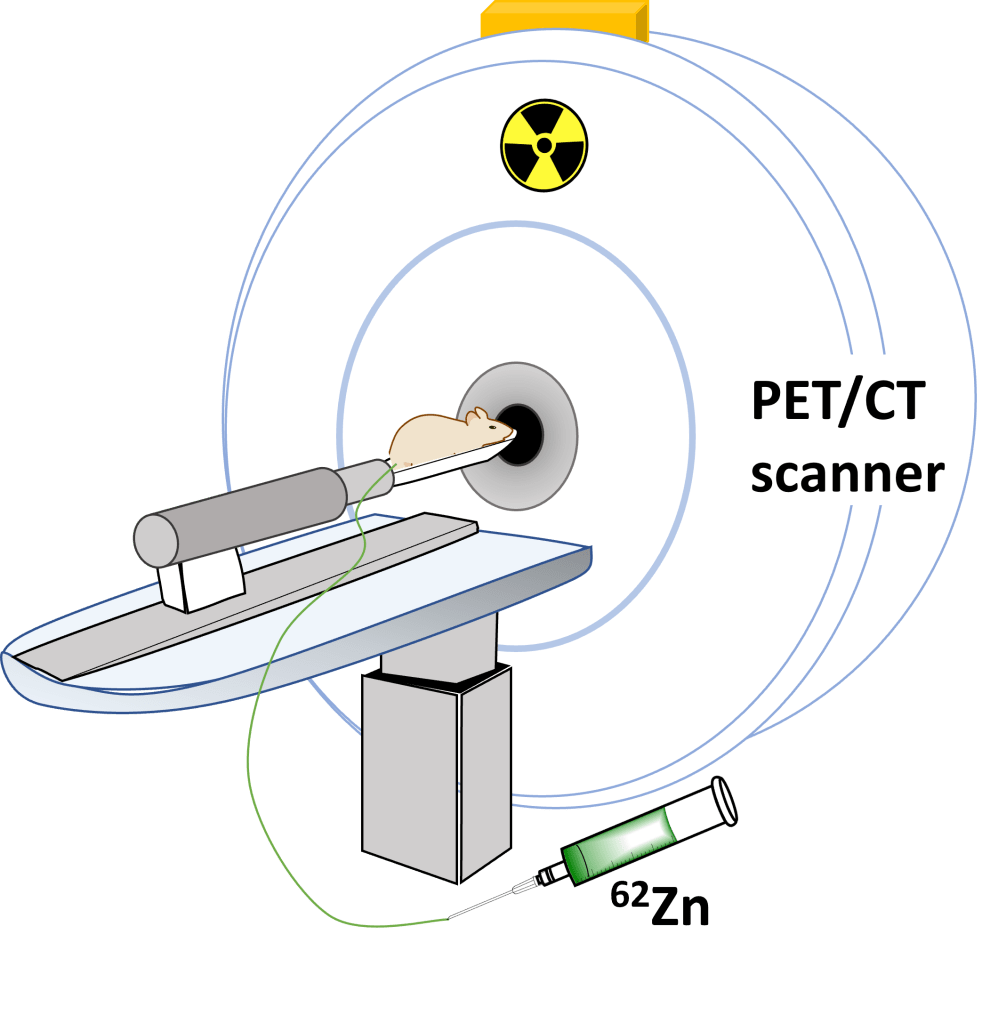
For more details, check out this review.
 Home
Home 